


Cement hydration is a highly complex process governed by a network of simultaneous interconnected dissolution-precipitation reactions. The resulting assembly of hydrate phases ultimately dictates the microstructural development, mechanical performance, and long-term durability of any cementitious material and its corresponding concrete. Historically, this evolution was viewed as a predominantly kinetically driven process, leading to a widespread consensus that classical thermodynamic methods could not be applied to such quasi-non-equilibrium systems. Recent advances in computational materials science have fundamentally challenged this paradigm. Research demonstrates that thermodynamic calculations can precisely predict phase stabilities and accurately track the progress of cement hydration, provided they are supported by a robust, internally consistent thermodynamic dataset and a related kinetic model. With the successful development of the so-called cemdata database, we are now in a position to accurately compute relevant liquid-solid phase equilibria of hydrating cements.
Beyond classic phase assemblages, this seminar explores the dynamic capability to identify critical equilibria changes during the hydration timeline. We try to come up with a novel framework for discussion: can these distinct thermodynamic transition points be coupled with modern sensing technologies in the field? Such integration could unlock real-time capabilities to accurately predict early-age concrete performance of concrete e.g. after placement or to detect anomalies in hardening behaviour. Finally, a potential use-case will be explored through a practical case study focusing on the thermodynamic detection of optimum sulfate levels in cement, illustrating how fundamental chemical equilibria can be translated into possible field monitoring setups.
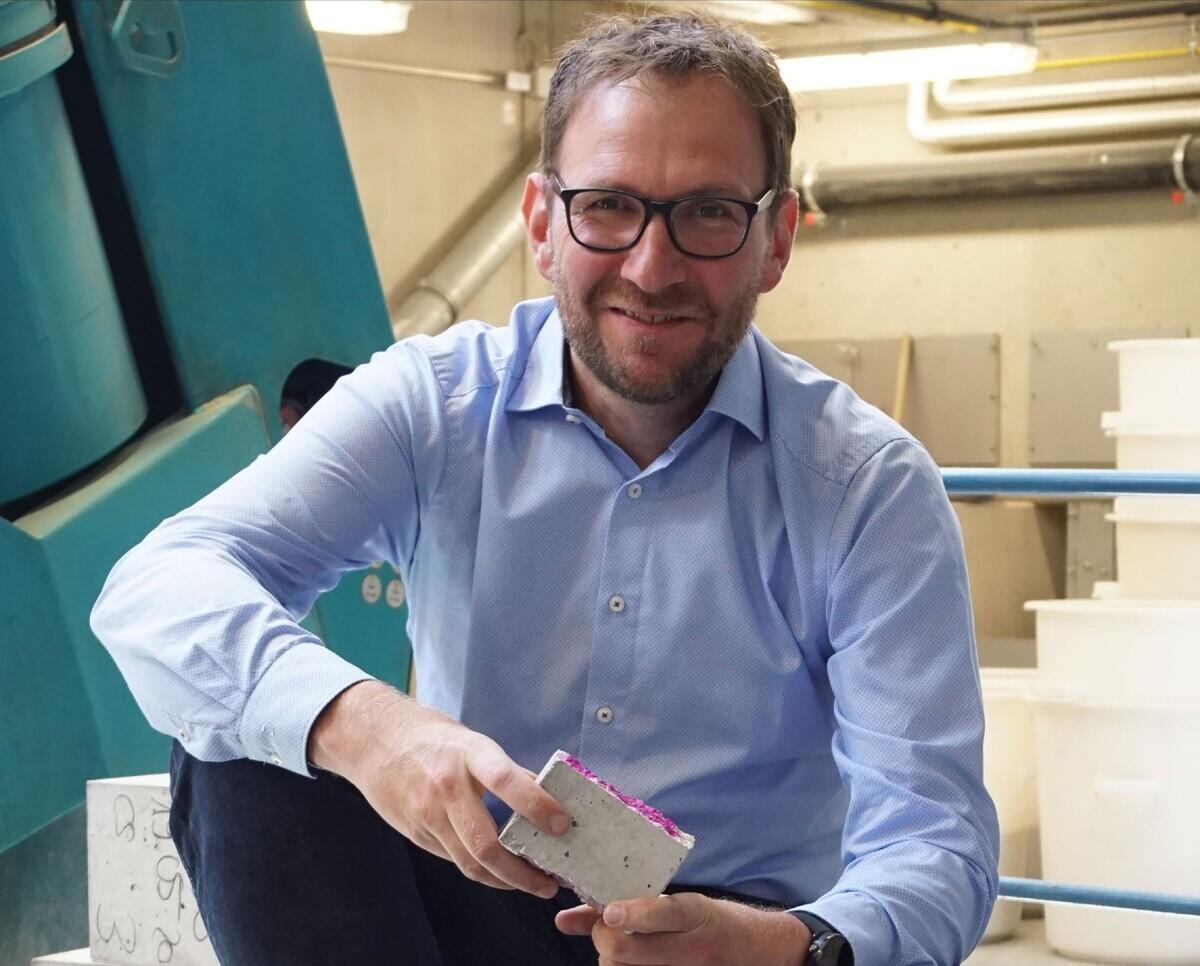
Prof. Thomas Matschei is a professor specializing in building materials, particularly cement and concrete. Since April 2026, he has been a professor at TU Braunschweig, leading research on sustainable and low-carbon construction materials, recycling, and CO₂ utilization.
Previously, he held professorships at RWTH Aachen University (2020–2026) and HTW Dresden (2017–2020), and worked for nearly a decade at LafargeHolcim in various research and leadership roles in cement and construction materials innovation.
He earned a PhD in cement chemistry from the University of Aberdeen and a diploma in civil engineering from Bauhaus University Weimar. His work focuses on sustainable construction, advanced concrete technologies, and material science.

Cement hydration is a highly complex process governed by a network of simultaneous interconnected dissolution-precipitation reactions. The resulting assembly of hydrate phases ultimately dictates the microstructural development, mechanical performance, and long-term durability of any cementitious material and its corresponding concrete. Historically, this evolution was viewed as a predominantly kinetically driven process, leading to a widespread consensus that classical thermodynamic methods could not be applied to such quasi-non-equilibrium systems. Recent advances in computational materials science have fundamentally challenged this paradigm. Research demonstrates that thermodynamic calculations can precisely predict phase stabilities and accurately track the progress of cement hydration, provided they are supported by a robust, internally consistent thermodynamic dataset and a related kinetic model. With the successful development of the so-called cemdata database, we are now in a position to accurately compute relevant liquid-solid phase equilibria of hydrating cements.
Beyond classic phase assemblages, this seminar explores the dynamic capability to identify critical equilibria changes during the hydration timeline. We try to come up with a novel framework for discussion: can these distinct thermodynamic transition points be coupled with modern sensing technologies in the field? Such integration could unlock real-time capabilities to accurately predict early-age concrete performance of concrete e.g. after placement or to detect anomalies in hardening behaviour. Finally, a potential use-case will be explored through a practical case study focusing on the thermodynamic detection of optimum sulfate levels in cement, illustrating how fundamental chemical equilibria can be translated into possible field monitoring setups.
Prof. Thomas Matschei is a professor specializing in building materials, particularly cement and concrete. Since April 2026, he has been a professor at TU Braunschweig, leading research on sustainable and low-carbon construction materials, recycling, and CO₂ utilization.
Previously, he held professorships at RWTH Aachen University (2020–2026) and HTW Dresden (2017–2020), and worked for nearly a decade at LafargeHolcim in various research and leadership roles in cement and construction materials innovation.
He earned a PhD in cement chemistry from the University of Aberdeen and a diploma in civil engineering from Bauhaus University Weimar. His work focuses on sustainable construction, advanced concrete technologies, and material science.
