

Alternative routes to the Haber-Bosch process are being sought to electrify ammonia synthesis, while it is very challenging to design a new route and find highly efficient catalysts. In this talk, I will show the development of theoretical and computational methods and data-driven application for electrochemical ammonia synthesis. The theoretical method is primarily based on reaction phase diagram analysis and electrochemical kinetics study. The reaction phase diagram aims to simplify the complex reaction network for rational design of catalysts. The electrochemical kinetics is used to understand the influence factors from the interfacial environments. Then, the recent experimental results validated many our theoretical and computational predictions in electrochemical ammonia synthesis. At last, the theoretical framework for catalyst design and mechanistic study will be addressed.
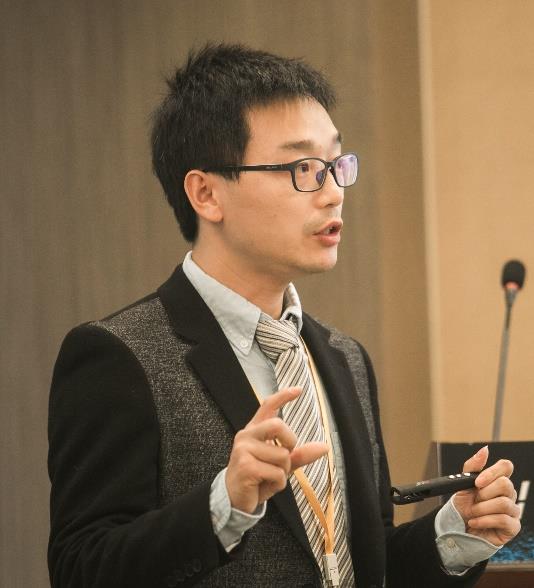
Prof. Dr. Jianping Xiao: studied his PhD at Bremen Center for Computational Materials Science, Universität Bremen, from 2009 to 2013, co-supervised by Prof. Thomas Frauenheim and Prof. Thomas Heine. He then worked as a postdoc fellow with Prof. Xinhe Bao at Dalian Institute of Chemical Physics, Chinese Academy of Sciences. Since 2015, he joined SUNCAT center led by Prof. Jens K. Nørskov at Stanford University. Since 2017, Prof. Xiao was appointed as assistant professor at Westlake University. After 2019, Prof. Xiao moved back to Dalian Institute of Chemical Physics, Chinese Academy of Sciences and been appointed as professor and the group leader in the group of Computation and Data Driven Catalysis. Recently his main research interests are developing methods for establishing reaction phase diagram to understand the evolution of activity, selectivity, and mechanism, also rationally design catalyst by artificial intelligence and machine learning techniques.

Alternative routes to the Haber-Bosch process are being sought to electrify ammonia synthesis, while it is very challenging to design a new route and find highly efficient catalysts. In this talk, I will show the development of theoretical and computational methods and data-driven application for electrochemical ammonia synthesis. The theoretical method is primarily based on reaction phase diagram analysis and electrochemical kinetics study. The reaction phase diagram aims to simplify the complex reaction network for rational design of catalysts. The electrochemical kinetics is used to understand the influence factors from the interfacial environments. Then, the recent experimental results validated many our theoretical and computational predictions in electrochemical ammonia synthesis. At last, the theoretical framework for catalyst design and mechanistic study will be addressed.
Prof. Dr. Jianping Xiao: studied his PhD at Bremen Center for Computational Materials Science, Universität Bremen, from 2009 to 2013, co-supervised by Prof. Thomas Frauenheim and Prof. Thomas Heine. He then worked as a postdoc fellow with Prof. Xinhe Bao at Dalian Institute of Chemical Physics, Chinese Academy of Sciences. Since 2015, he joined SUNCAT center led by Prof. Jens K. Nørskov at Stanford University. Since 2017, Prof. Xiao was appointed as assistant professor at Westlake University. After 2019, Prof. Xiao moved back to Dalian Institute of Chemical Physics, Chinese Academy of Sciences and been appointed as professor and the group leader in the group of Computation and Data Driven Catalysis. Recently his main research interests are developing methods for establishing reaction phase diagram to understand the evolution of activity, selectivity, and mechanism, also rationally design catalyst by artificial intelligence and machine learning techniques.
