

Responsive hybrid materials may appear simple in their final form, for example as a colored spot, a luminescent layer, or a patterned microstructure. Their function is encoded in how dyes are confined, how local polarity and sol–gel chemistry evolve over time, and how structure emerges during processing. This talk presents a research path from dye chemistry to functional sol–gel and ionogel architectures designed for application-relevant, eye-readable readouts, with an outlook on the possible use of electron beams for structuring and spatially controlling responsive hybrid materials.
The talk starts with silica-based hosts doped with xanthene dyes and shows how molecular photophysics can be translated into robust optical response under practical constraints[1]. This includes dye impregnation routes for luminescent food-spoilage sensing[2] and annealed sol–gel layers where emission can be tuned through concentration and remains stable at elevated temperatures[3]. The next part moves to silica ionogels, where the ionic liquid stops being only a solvent or additive and becomes a control parameter. By selecting the ionic-liquid composition and using sol–gel kinetics intentionally, the response rate and thermal sensitivity can be programmed, leading to visual time indicators that encode cumulative thermal exposure as a reproducible color trajectory.
Current work therefore shifts toward microstructures, including disk-like micro-features that combine thermal stability with reversible, stimulus-responsive behavior in dye-based and dye-doped ionogels. In parallel, electron-beam-induced structuring of ionic liquids has been demonstrated[4], indicating that the beam can act as a practical tool to introduce spatial organization within these systems. Electron beam thus offers a route to write, localize, and tune functionality in space, enabling direct-write patterns, gradients, and multistate response maps. The next step is to explore how the electron beam can be used as a practical processing tool to structure these materials and to tune functionality locally.
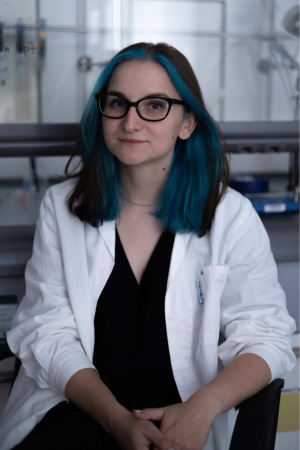
Maria Zdończyk is a postdoctoral researcher at the E-BEAM Centre at VSB – Technical University of Ostrava (Czech Republic), where she works on thin organic films and their transformations under electron-beam irradiation. She obtained her PhD in chemistry, focusing on luminescent sol–gel and ionogel thin films for optical sensing including systems designed for high-temperature stability and time–temperature indicators. In her current research, she investigates how electron beam can be used to drive and control chemical and functional changes in organic and hybrid layers, aiming toward spatially programmable, multi-state material responses.

Responsive hybrid materials may appear simple in their final form, for example as a colored spot, a luminescent layer, or a patterned microstructure. Their function is encoded in how dyes are confined, how local polarity and sol–gel chemistry evolve over time, and how structure emerges during processing. This talk presents a research path from dye chemistry to functional sol–gel and ionogel architectures designed for application-relevant, eye-readable readouts, with an outlook on the possible use of electron beams for structuring and spatially controlling responsive hybrid materials.
The talk starts with silica-based hosts doped with xanthene dyes and shows how molecular photophysics can be translated into robust optical response under practical constraints[1]. This includes dye impregnation routes for luminescent food-spoilage sensing[2] and annealed sol–gel layers where emission can be tuned through concentration and remains stable at elevated temperatures[3]. The next part moves to silica ionogels, where the ionic liquid stops being only a solvent or additive and becomes a control parameter. By selecting the ionic-liquid composition and using sol–gel kinetics intentionally, the response rate and thermal sensitivity can be programmed, leading to visual time indicators that encode cumulative thermal exposure as a reproducible color trajectory.
Current work therefore shifts toward microstructures, including disk-like micro-features that combine thermal stability with reversible, stimulus-responsive behavior in dye-based and dye-doped ionogels. In parallel, electron-beam-induced structuring of ionic liquids has been demonstrated[4], indicating that the beam can act as a practical tool to introduce spatial organization within these systems. Electron beam thus offers a route to write, localize, and tune functionality in space, enabling direct-write patterns, gradients, and multistate response maps. The next step is to explore how the electron beam can be used as a practical processing tool to structure these materials and to tune functionality locally.
Maria Zdończyk is a postdoctoral researcher at the E-BEAM Centre at VSB – Technical University of Ostrava (Czech Republic), where she works on thin organic films and their transformations under electron-beam irradiation. She obtained her PhD in chemistry, focusing on luminescent sol–gel and ionogel thin films for optical sensing including systems designed for high-temperature stability and time–temperature indicators. In her current research, she investigates how electron beam can be used to drive and control chemical and functional changes in organic and hybrid layers, aiming toward spatially programmable, multi-state material responses.
