


Carbon materials with their high surface area and abundant functionality, best made from simple circular starting products, are a powerful case to illustrate the potential of nanomaterials. Here, the notation “carbon” is rather broad and includes a diversity of covalent organic compounds with different composition, architecture, textures and the related properties. A common denominator is however that all these systems are insoluble, rather inert solids, where the beauty of chemistry lies in nanostructure control, I will show that such carbons, sometimes combined with inorganic nanostructures, are chemo-, photo- and electrocatalytically active and show even enzyme-like activity for some very unusual reactions, such as binding and conversion from nanomolar concentrations for environmental cleaning or polymer degradation of otherwise stable polymers. As such, these carbo-catalyst are not the “green versions” of previous catalysts with “compromised” properties, but they extend chemistry as such. If time allows, I will also talk about how to use the same general nanoeffects for disruptive energy storage.
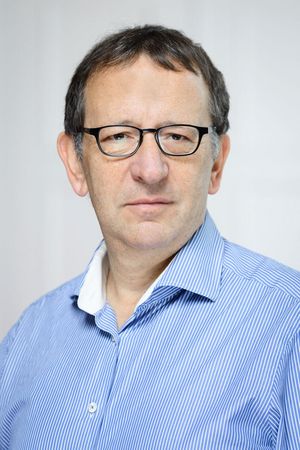
Markus Antonietti is director of the Max Planck Institute (MPI) of Colloids and Interfaces and has contributed with about 1.000 papers to the field of materials/polymer chemistry in the last 40 years. His work was appreciated with a number of honours, and his current work is cited about 200000 times, with an H-index of 222. He is also an amateur chef of fusion cuisine and is playing in a rock band.

Carbon materials with their high surface area and abundant functionality, best made from simple circular starting products, are a powerful case to illustrate the potential of nanomaterials. Here, the notation “carbon” is rather broad and includes a diversity of covalent organic compounds with different composition, architecture, textures and the related properties. A common denominator is however that all these systems are insoluble, rather inert solids, where the beauty of chemistry lies in nanostructure control, I will show that such carbons, sometimes combined with inorganic nanostructures, are chemo-, photo- and electrocatalytically active and show even enzyme-like activity for some very unusual reactions, such as binding and conversion from nanomolar concentrations for environmental cleaning or polymer degradation of otherwise stable polymers. As such, these carbo-catalyst are not the “green versions” of previous catalysts with “compromised” properties, but they extend chemistry as such. If time allows, I will also talk about how to use the same general nanoeffects for disruptive energy storage.
Markus Antonietti is director of the Max Planck Institute (MPI) of Colloids and Interfaces and has contributed with about 1.000 papers to the field of materials/polymer chemistry in the last 40 years. His work was appreciated with a number of honours, and his current work is cited about 200000 times, with an H-index of 222. He is also an amateur chef of fusion cuisine and is playing in a rock band.
