 Ultrasensitive Label-Free Detection of Free Thyroxine (T4) in Physiological Ranges Using Aptamer-Functionalized Silicon Nanowire Field Effect Transistors
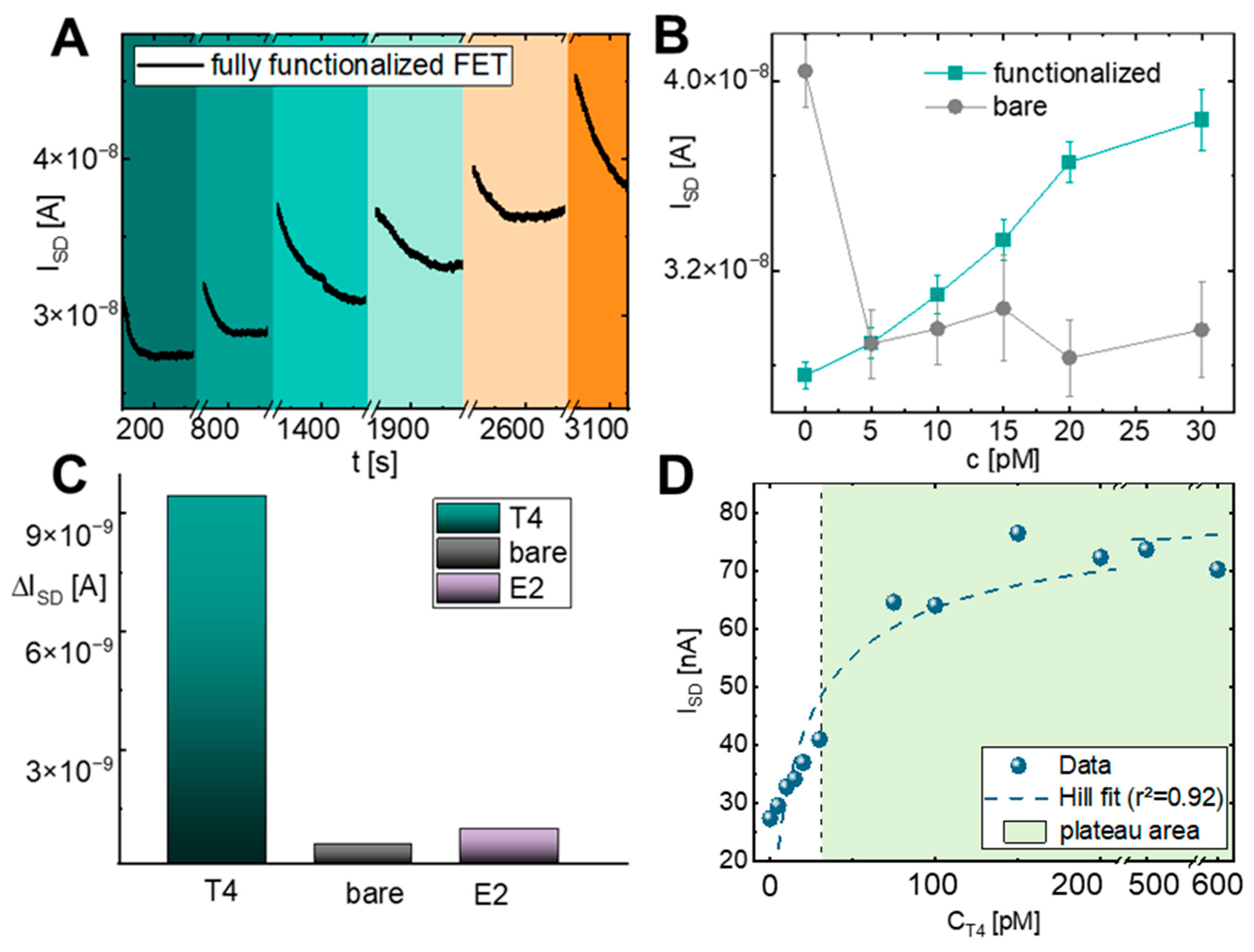
Thyroxine (T4) is a key hormone regulating metabolic, cardiovascular, and neurodevelopmental processes, yet its clinical quantification still relies on centralized immunoassays that limit rapid or point-of-care monitoring. Here, we present a label-free biosensing platform based on silicon nanowire field-effect transistors (SiNW-FETs) functionalized with a T4-selective DNA aptamer via a 3-Triethoxysilyl propylsuccinic Anhydride (TESPSA)-mediated silanization approach, enabling a streamlined two-step modification for oriented immobilization. The biosensor achieves robust real-time detection of T4 across the physiological concentration range (5–30 pM), with a limit of detection of ~5 pM and a strong linear correlation between drain current and analyte concentration (R2 = 0.9931). Specificity is confirmed using non-functionalized devices and estradiol as a non-target control. All measurements were performed in undiluted phosphate-buffered saline, representing a physiologically relevant ionic environment and demonstrating stable sensor performance under realistic buffer conditions. The dose–response behavior follows a Hill model, allowing extraction of binding parameters and confirming that the electrical signal originates from specific aptamer–target interactions. These results demonstrate that aptamer-functionalized SiNW-FETs provide a highly sensitive, selective, and miniaturizable platform for quantitative thyroid hormone monitoring, with strong potential for future point-of-care applications.
 Ultrasensitive Label-Free Detection of Free Thyroxine (T4) in Physiological Ranges Using Aptamer-Functionalized Silicon Nanowire Field Effect Transistors
Thyroxine (T4) is a key hormone regulating metabolic, cardiovascular, and neurodevelopmental processes, yet its clinical quantification still relies on centralized immunoassays that limit rapid or point-of-care monitoring. Here, we present a label-free biosensing platform based on silicon nanowire field-effect transistors (SiNW-FETs) functionalized with a T4-selective DNA aptamer via a 3-Triethoxysilyl propylsuccinic Anhydride (TESPSA)-mediated silanization approach, enabling a streamlined two-step modification for oriented immobilization. The biosensor achieves robust real-time detection of T4 across the physiological concentration range (5–30 pM), with a limit of detection of ~5 pM and a strong linear correlation between drain current and analyte concentration (R2 = 0.9931). Specificity is confirmed using non-functionalized devices and estradiol as a non-target control. All measurements were performed in undiluted phosphate-buffered saline, representing a physiologically relevant ionic environment and demonstrating stable sensor performance under realistic buffer conditions. The dose–response behavior follows a Hill model, allowing extraction of binding parameters and confirming that the electrical signal originates from specific aptamer–target interactions. These results demonstrate that aptamer-functionalized SiNW-FETs provide a highly sensitive, selective, and miniaturizable platform for quantitative thyroid hormone monitoring, with strong potential for future point-of-care applications.