Chiral molecules in nature usually show optical activity only in the deep ultraviolet, whereas artificial chiral plasmonic nanostructures can generate much stronger responses at visible and near-infrared wavelengths. An important challenge is whether the abundant biomolecular chirality in nature can be directly transferred to achiral plasmonic systems without elaborate three-dimensional nanofabrication. Here we show that the mechanical stretching of protein molecules anchored within achiral gold nanoparticle assemblies strongly enhances and reversibly modulates plasmon-coupled circular dichroism. Stretching amplifies the chiroptical response to an ellipticity of 1.18° and a dissymmetry factor of 0.2, far exceeding conventional hotspot-based strategies. Repeated stretching and relaxation further enable reversible switching over more than 100 cycles. Simulations and in situ spectroscopy indicate that the deformation of protein changes its conformation and dipole alignment, thereby strengthening the plasmonic chiral response. These findings establish a route to achieve dynamically controllable chiroptical activity in achiral plasmonic assemblies, revealing how small biomolecular deformations can strongly influence plasmonic responses of much larger nanostructures.
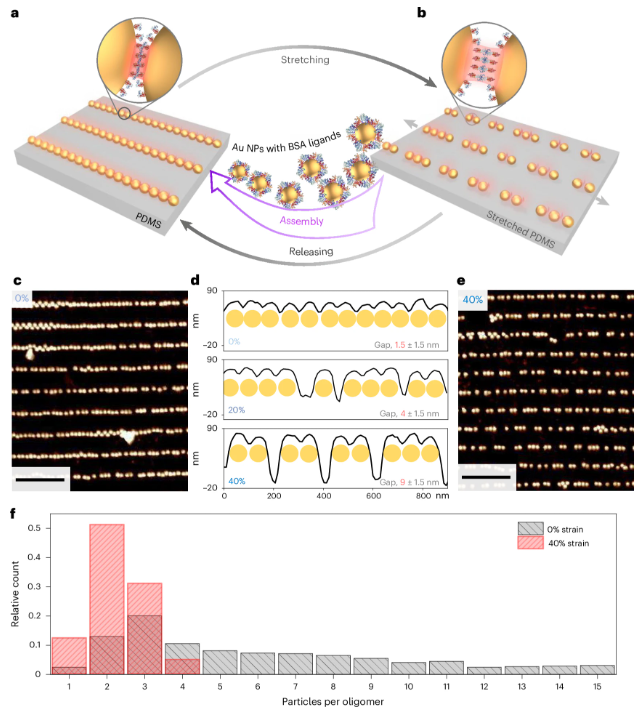

Chiral molecules in nature usually show optical activity only in the deep ultraviolet, whereas artificial chiral plasmonic nanostructures can generate much stronger responses at visible and near-infrared wavelengths. An important challenge is whether the abundant biomolecular chirality in nature can be directly transferred to achiral plasmonic systems without elaborate three-dimensional nanofabrication. Here we show that the mechanical stretching of protein molecules anchored within achiral gold nanoparticle assemblies strongly enhances and reversibly modulates plasmon-coupled circular dichroism. Stretching amplifies the chiroptical response to an ellipticity of 1.18° and a dissymmetry factor of 0.2, far exceeding conventional hotspot-based strategies. Repeated stretching and relaxation further enable reversible switching over more than 100 cycles. Simulations and in situ spectroscopy indicate that the deformation of protein changes its conformation and dipole alignment, thereby strengthening the plasmonic chiral response. These findings establish a route to achieve dynamically controllable chiroptical activity in achiral plasmonic assemblies, revealing how small biomolecular deformations can strongly influence plasmonic responses of much larger nanostructures.

 Efficient and reversible chirality induction between protein and achiral plasmonic assemblies