 Wafer-scale Pd-decorated Ta2O5/SnO2 heterojunction sensor for ultrafast and sensitive hydrogen detection
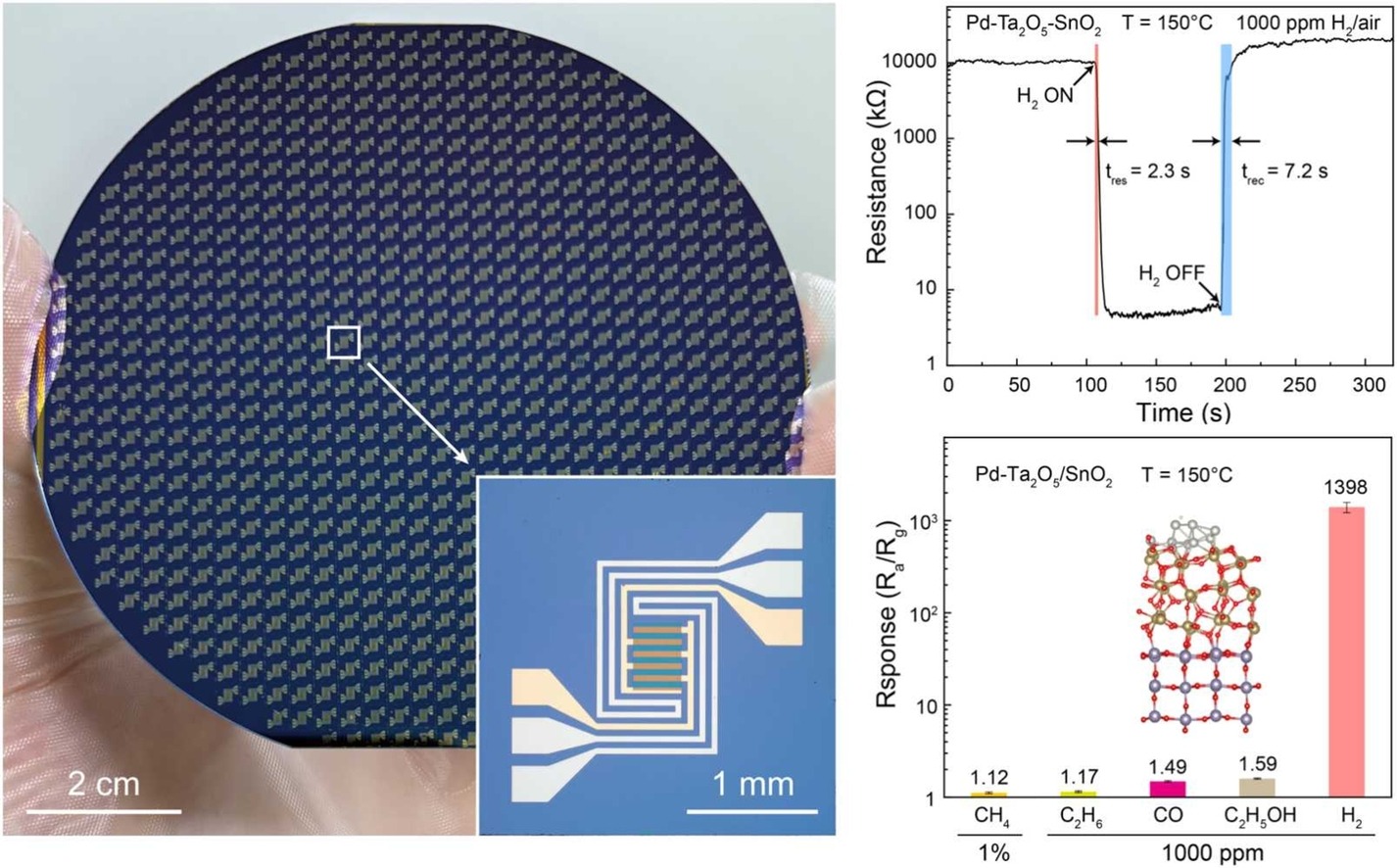
With the large-scale deployment of hydrogen energy, rapid and accurate detection of low-concentration hydrogen has become critical for maintaining safety protocols and preventing potential hazards. While nanostructuring approaches and noble metal dopants can improve metal oxide semiconductor (MOS) sensor kinetics, batch-fabricated devices via sputtering still face challenges in balancing speed, response, and stability. Here, we report an advanced hydrogen sensor based on a Ta2O5/SnO2 heterostructure decorated with Pd nanoparticles (NPs), fabricated via a wafer-scale, highly controllable sputtering process. The sensor exhibits ultrafast response/recovery kinetics (2.3/7.2 s) while maintaining a high response (Ra/Rg) of 1398 for 1000 ppm H2/air at 150°C. Moreover, the sensor demonstrates a low 2 ppm detection limit, along with superior repeatability and selectivity. To investigate the sensing mechanism, DFT calculations are adopted to study the adsorption behavior of oxygen at the molecular level. According to the computation results, Ta2O5/SnO2 exhibits a higher adsorption energy (0.75 eV) for oxygen compared to SnO2 (0.05 eV). Therefore, the accelerated recovery behavior observed in the Pd-Ta2O5/SnO2 sensor arises from the enhanced oxygen adsorption capacity of the proposed heterostructure. This work not only advances practical H2 sensing, but also offers design insights into multicomponent heterojunction architectures for high-performance sensors.
 Wafer-scale Pd-decorated Ta2O5/SnO2 heterojunction sensor for ultrafast and sensitive hydrogen detection
With the large-scale deployment of hydrogen energy, rapid and accurate detection of low-concentration hydrogen has become critical for maintaining safety protocols and preventing potential hazards. While nanostructuring approaches and noble metal dopants can improve metal oxide semiconductor (MOS) sensor kinetics, batch-fabricated devices via sputtering still face challenges in balancing speed, response, and stability. Here, we report an advanced hydrogen sensor based on a Ta2O5/SnO2 heterostructure decorated with Pd nanoparticles (NPs), fabricated via a wafer-scale, highly controllable sputtering process. The sensor exhibits ultrafast response/recovery kinetics (2.3/7.2 s) while maintaining a high response (Ra/Rg) of 1398 for 1000 ppm H2/air at 150°C. Moreover, the sensor demonstrates a low 2 ppm detection limit, along with superior repeatability and selectivity. To investigate the sensing mechanism, DFT calculations are adopted to study the adsorption behavior of oxygen at the molecular level. According to the computation results, Ta2O5/SnO2 exhibits a higher adsorption energy (0.75 eV) for oxygen compared to SnO2 (0.05 eV). Therefore, the accelerated recovery behavior observed in the Pd-Ta2O5/SnO2 sensor arises from the enhanced oxygen adsorption capacity of the proposed heterostructure. This work not only advances practical H2 sensing, but also offers design insights into multicomponent heterojunction architectures for high-performance sensors.